
HS Codes for Import from China: 2026 Tariff & Lookup Guide
Last updated: August 10, 2026
When Danielle’s first container of stainless kitchen tools left the port of Ningbo, she thought the hard part was over. The Alibaba supplier had been responsive, the samples looked perfect, and the freight forwarder quoted a number she could live with. Three weeks later the shipment hit US Customs and stalled for 19 days. The reason had nothing to do with the product and everything to do with a string of digits she had copied from a friend’s old invoice: 8516.79. That code described electric heating appliances, not her manual strainers. Customs rejected the entry, reassessed the duty, and billed a penalty on top. Danielle’s $14,000 order cost her another $2,300 in tariffs, fees, and demurrage before it ever reached her warehouse.
Getting hs codes for import from china right is the highest-return habit you can build. It determines your duty rate, your clearance speed, your freight classification, and whether a shipment sails through or sits in a bonded warehouse racking up storage. Yet most first-time importers treat the HS code as a box their supplier fills in. That assumption is where margins go to die.
This guide walks you through exactly how HS codes work, how to look one up in four steps, what the 2026 tariff reality looks like for China-origin goods, and how a single wrong digit can rewrite your landed cost. Do this and you’ll classify your own products with confidence — and know exactly when a second look pays off.
Key Takeaways
– An HS code is a 6-digit international product ID; the US adds 4 more digits (HTS) and the EU adds 2 (CN) to set the exact duty rate.
– In 2026 your combined US duty on China goods stacks three layers: the MFN base rate, the Section 301 tariff, and the IEEPA reciprocal tariff. Together they push cotton tees (6109.10) to about 34% and plastic phone cases past 52%.
– Misclassification penalties run 5%–30% of cargo value, plus clearance delays and possible rejection or forced return.
– The $800 de minimis duty-free exemption was suspended for China in May 2025 and globally by February 2026, so every shipment now needs a correct 10-digit HTS code and a formal entry.
– A free HS code lookup before you order lets you price accurately, choose the right freight terms, and avoid the most expensive surprises at the border.
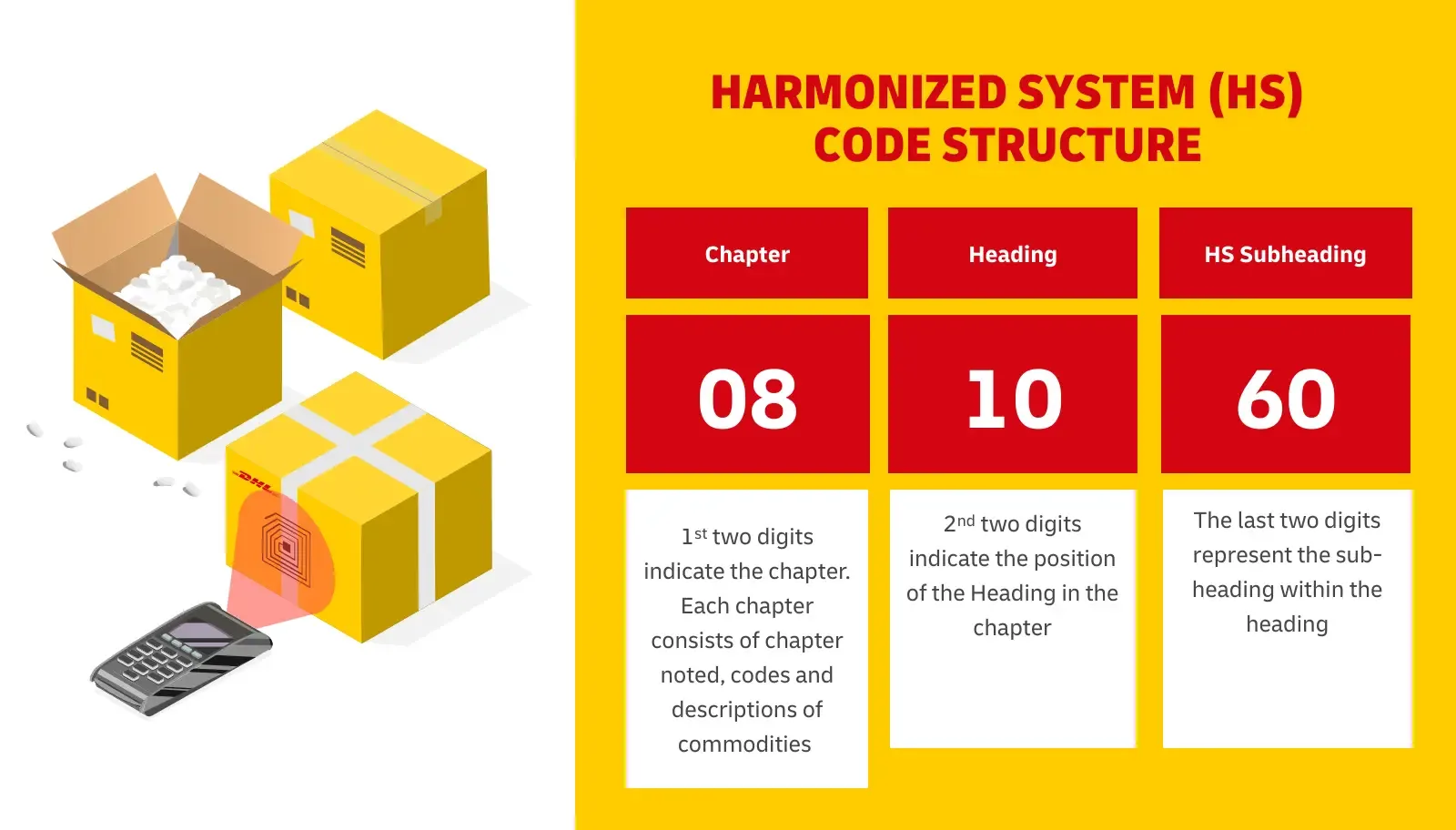
What Exactly Is an HS Code?
An HS code (Harmonized System code) is a 6-digit international number that identifies a traded product; the US adds 4 digits (HTS) and the EU adds 2 (CN) to set the exact duty rate. Customs uses this number to decide what you owe.
An HS code is a standardized numerical identifier for traded products. It is maintained by the World Customs Organization (WCO) and used by more than 200 countries. Think of it as the universal “noun” for a physical good crossing a border. Officers in Los Angeles and Hamburg speak different languages. But they both read “6109.10” the same way: a cotton knit t-shirt. Every item you order from a Chinese factory maps to one of these numbers, and your China HS code is simply this global system seen through a US or EU lens.
The system is hierarchical. Each pair of digits narrows the category:
- Chapter (first 2 digits) – the broad product family (e.g., 61 = articles of apparel and clothing accessories, knitted or crocheted).
- Heading (first 4 digits) – a more specific group within the chapter (e.g., 6109 = t-shirts, singlets and similar).
- Subheading (first 6 digits) – the internationally agreed definition (e.g., 6109.10 = t-shirts of cotton).
That 6-digit subheading is the part every country on earth shares. It is the common backbone of global trade. New importers trip on what comes next: the 6-digit code tells customs what your product is, not how much duty you owe. The duty rate lives in the extra digits each country appends.
The 6-Digit International Standard
The first six digits are identical worldwide because they come straight from the WCO Harmonized System. If you only ever see a 6-digit code on a supplier’s quote, that is normal for early sourcing conversations. It is enough to identify the product category, but it is never enough to file a US or EU customs entry on its own. The moment your goods approach a real border, the receiving country wants its own extended version. The shared 6-digit base is the starting point for every China import code you will ever file, before any country adds its own digits.
US HTS: 10 Digits and Why the Last 4 Matter
In the United States, the HS code becomes the HTSUS (Harmonized Tariff Schedule of the United States). It runs to 10 digits:
- Digits 1–6: the international HS subheading.
- Digits 7–8: the US statistical suffix (used for trade data; usually does not change duty).
- Digits 9–10: the US tariff rate line — this is where your actual duty percentage is set.
A small shift in the final two digits can move a product from a 0% rate to a 25% rate. That is why “close enough” classification is a liability. US importers must declare the full 10-digit HTS on every formal entry. There is also a special Chapter 99 set of codes layered on top to capture Section 301 and other trade remedies — more on those shortly.
If the US vs HTS distinction is still fuzzy, our deeper guide on HS code vs HTS code breaks down exactly where the two diverge and when each term applies.
EU CN Codes: 8 Digits
The European Union uses the Combined Nomenclature (CN), an 8-digit code. The first six are the international HS; the 7th and 8th are the EU’s own subheadings that set the duty under the EU’s Common Customs Tariff. For the most granular EU measures (anti-dumping, quotas, suspensions), a further 2 digits produce a TARIC 10-digit code. EU importers almost always work from the 8-digit CN, with TARIC consulted when a product is subject to a special measure.
Same shirt, three codes: the same cotton t-shirt might be “6109.10” internationally, “6109.10.0012” on a US entry, and “6109.10.00” on an EU one. Same product, three codes, three different places to find your rate.
Why HS Codes Are Make-or-Break for China Importers
If you buy from Alibaba, 1688, or any mainland factory, your HS code drives your whole cost model. Three forces make them more important in 2026 than at any point in the last decade.
Start with the tariff stack. China-origin goods carry the heaviest tariff stack in the US schedule. The Section 301 tariffs imposed since 2018 are still fully in force, and they are added on top of the normal duty. Your HS code is the switch that turns that stack on or off — and determines which rate within it applies.
Then there’s de minimis. The end of the exemption (covered below) means low-value test orders and sample shipments no longer slip through duty-free. Every parcel now needs a real HTS code and a formal entry. You can no longer outsource the classification question to “it’s under $800, who cares.”
And your forwarder prices around the code you declare. A vague or wrong code triggers inspections, bonds, and storage that you pay for by the day.
Buyers who treat classification as a shared homework exercise — rather than a supplier chore — consistently land cheaper and clear faster. Our dedicated guide to HS codes for Alibaba and 1688 buyers shows the exact workflow we recommend for negotiating on a code you have already verified.
Ready to see your own number before you order? Check it yourself on your product description and get the international subheading in seconds — then take it into the four-step method below to confirm the full 10-digit HTS.
How to Look Up an HS Code in 4 Steps
To look up an HS code: (1) write a precise description, (2) determine material and use, (3) run a lookup tool, (4) verify the 10-digit HTS.
You do not need a customs license to classify most products well. You need a precise description, a little structured reasoning, and a reliable tool. Here is the four-step method our team uses for every China goods classification review before a purchase order is signed.
Step 1: Write a Precise Product Description
Start with what the product is, not what it is for. “Phone accessory” is useless. “Protective case molded from thermoplastic polyurethane (TPU) for iPhone 15, non-waterproof” is classifiable. Capture:
- The material (cotton, stainless steel, silicone, ABS plastic).
- The form (knitted, forged, printed circuit board).
- The function (storage, illumination, power delivery).
- Any defining feature (wireless charging compatible, child-sized, rechargeable).
The more specific you are, the fewer wrong branches you will wander down. Suppliers often describe goods by marketing name; customs describes them by physical nature. Translate from the former to the latter.
Step 2: Determine Material and Primary Use
HS chapters are built around material first, function second. Chapter 61 is knitted apparel regardless of who wears it; Chapter 85 is electrical machinery regardless of brand. Ask two questions:
- What is it principally made of? A bag that is 70% cotton and 30% leather is classified by its cotton chief weight, not its leather trim.
- What is its principal use? A garment sold as a “beach cover-up” may still be classified as a t-shirt if that is its essential character.
When a product could fit two chapters, the General Rules of Interpretation (GRI) decide. For most consumer goods, material and primary function resolve it. When in doubt, the descriptive wording on the official schedule usually mirrors your Step 1 sentence almost exactly.
Step 3: Use an HS Code Lookup Tool
Now put that description into a search tool. A good HS Code Lookup returns candidate 6-digit subheadings with plain-language descriptions so you can match your product. Those subheadings are the backbone of HS codes for China imports — the same 6-digit language every destination country then extends in its own way. Start broad (search “t-shirt cotton”), then read the official wording of each candidate heading to confirm fit. Tool results are a starting point, not a filing — always verify the extended code for your destination country in Step 4.
For a head-start by product family, our HS code list by category groups the most common China-sourced goods (apparel, electronics, home, beauty, outdoor) with their base subheadings so you can jump straight to the right chapter.
Step 4: Verify the 10-Digit HTS for Your Market
Take the 6-digit subheading into the official schedule for your destination:
- United States: hts.usitc.gov — confirm digits 7–10 and check the Chapter 99 box for any Section 301 surcharge.
- European Union: the TARIC database — confirm the 8-digit CN and any TARIC measure.
- Other markets: each customs authority publishes its own extended schedule.
This is the step where the real rate is revealed. A 6-digit lookup tells you the family; the 10-digit HTS tells you the bill.
Mini story — Marcus saves a 25% hit. Marcus runs a Shopify store in Austin and ordered his first batch of LED strip lights from a Shenzhen factory. The supplier wrote “9405.42” on the pro forma invoice — the code for LED lamps and lighting fittings. Marcus ran a quick HS Code Lookup on “self-adhesive LED strip, flexible, without fitting,” and the tool pointed him to 9405.42 as well, but with a note that strips sold by the reel without a fixture can fall under a different statistical line. He opened the HTS and confirmed the exact 10-digit line his broker would file. When his forwarder later quoted duties using the wrong suffix, Marcus caught it, the broker refiled correctly, and he avoided a 25% Section 301 misclassification penalty on a $9,000 order. The lookup took four minutes.
Real 2026 Section 301 Tariff Examples
Now the theory costs real money. On hs codes for import from china, one subheading can mean the difference between a 34% tee and a 52% phone case at the border. For the full Section 301 tariff breakdown by product and Chapter 99 code, see our dedicated guide.
A US importer of China-origin goods typically pays a stacked duty:
Total duty ≈ MFN base rate + Section 301 tariff + IEEPA reciprocal tariff (+ any Chapter 99 surcharge)
The MFN (Most Favored Nation) rate is the normal column-1 rate. Section 301 is the China-specific trade-remedy tariff (7.5% on List 4A consumer goods, 25% on Lists 1–3). The IEEPA reciprocal tariff is the 2025–2026 country-level layer (commonly 10% for China-origin). The exact combination depends on your 10-digit HTS and current Chapter 99 instructions, so always confirm against the live schedule. These examples show how far a single code reaches.
| Product | HS Code | MFN | Section 301 | IEEPA | Total |
|---|---|---|---|---|---|
| Cotton T-shirt | 6109.10 | ~16.5% | 7.5% (List 4A) | ~10% | ~34% |
| Plastic phone case | 3926.90 | ~5.3% | 25% (List 3) + extra 2026 surcharge | ~10% | ~52.6% |
| Lithium power bank | 8507.60 | low | 25% | ~10% | 35%+ |
| USB cable | 8544.42 | ~3.5% | 25% | ~10% | ~38.5% |
Cotton T-Shirts (6109.10) ≈ 34%
Among HS codes for China imports, apparel is the highest-burden family, and this code is the reason why. A men’s cotton knit t-shirt classified under 6109.10 carries an MFN base rate of 16.5%. Add the Section 301 List 4A surcharge of 7.5% and the IEEPA reciprocal layer of about 10%, and the effective rate lands near 34%. On a $10,000 shipment that is roughly $3,400 in duty before you add the Merchandise Processing Fee. Apparel is one of the highest-burden categories for China sourcing, and the HS code is the only thing that files it correctly.
Plastic Phone Cases ≈ 52.6%
The molded plastic phone case is the textbook case of why the right HS code decides your cost, not your purchase price. A molded plastic phone case typically falls under 3926.90 (other articles of plastics). The MFN base is around 5.3%. On top sits the Section 301 List 3 surcharge of 25%, the IEEPA reciprocal layer near 10%, and an additional 2026 Section 301 surcharge that pushes the combined total past 52% — close to 52.6% for many listings. A $5 case that costs $1.50 to make can owe more in US duty than it did at the factory. This is the clearest illustration of why the HS code, not the purchase price, drives your true cost.
Electronics: A Split Story
Electronics behave unpredictably by code, which is exactly why lookup matters:
- Smartphones (8517.13): MFN 0%, long-standing Section 301 exclusion, IEEPA ~10% → often around 10% total.
- Laptops and tablets (8471): similarly 0% MFN with exclusions; the IEEPA layer dominates.
- Lithium power banks (8507.60): low MFN but a 25% Section 301 surcharge applies → 35%+ combined.
- USB cables (8544.42): ~3.5% MFN + 25% Section 301 + IEEPA → ~38.5%.
Two products that feel like “electronics” can sit 40 points apart in duty. Only the HTS decides.
For the current rates by product and Chapter 99 code, see our guide to 2026 Section 301 tariffs by HS code.
Mini story — Priya reprices before the border bites. Priya launched an Amazon FBA brand in New Jersey with cotton blend tees from a Guangzhou mill. Her supplier’s quote assumed a “small duty, around 5%.” Priya ran the product through a HS Code Lookup, confirmed 6109.10, and opened our import duty calculator with the 10-digit line. The real combined rate came back at ~34%. She had been about to list the shirts at a price that would have lost money on every unit after tariff and fulfillment. She repriced, switched part of her volume to a Vietnam mill for future runs, and protected her launch margin. The 30 minutes she spent on classification saved the product line.
The Real Cost of Getting Classification Wrong
Customs treats a wrong HS code as a legal declaration, not a typo. Errors carry consequences that scale with cargo value.
Fines of 5%–30% of Cargo Value
US Customs and Border Protection can assess penalties under 19 U.S.C. 1592 for negligent or fraudulent misclassification. Negligent errors commonly draw penalties in the range of 5% to 30% of the dutiable value of the shipment — not 5%–30% of the duty, but of the cargo’s value. On Danielle’s $14,000 order, even a 15% penalty is $2,100 before any back duty. Repeated or willful errors escalate toward the statutory maximum and can trigger audits of your entire import history.
Clearance Delays and Storage
A mismatched or unsupported code sends your entry into review. Customs may request a binding ruling, demand laboratory testing for material content, or simply hold the container. While it sits, you pay demurrage and detention to the terminal and carrier — often $75–$150 per day for a standard container. A two-week hold can cost more than the duty itself. Delays also break your inventory promise to customers and can suspend your listing or pre-order.
Rejection and Forced Return
In the worst cases the goods are refused entry. You then choose between re-exporting (paying freight both ways) or destroying the shipment under CBP supervision. Either way the product is gone and the cost is sunk. Importers who classify carelessly to “move fast” usually move slowest of all.
Our guide to common HS code mistakes and the fines they trigger catalogs the ten errors we see most often — from trusting a supplier’s stale code to misreading “chief weight” rules — and how to avoid each one.
HS Codes, Customs Clearance & Your Landed Cost
The code shapes three more numbers that decide if your order pays off. Accurate hs codes for import from china flow into freight, clearance, and total landed cost.
HS Code → Customs Clearance Speed
Brokers file your HTS into the ACE system, and CBP risk-scans the entry against the code. A clean, well-supported 10-digit code with a matching description clears in hours. A vague or conflicting code invites an exam. The single best thing you can do to speed customs clearance from China is to hand your broker a code you have already verified, with the product description that justifies it.
HS Code → Freight and Routing
Carriers and terminals use the HS chapter to apply handling rules, especially for batteries, chemicals, and cosmetics. A power bank (8507.60) moves under different dangerous-goods rules than a cotton shirt (6109.10), and the freight quote reflects that. Accurate classification means an accurate freight quote — and no surprise re-classification surcharge when the airline’s compliance team reopens your booking.
HS Code → Total Landed Cost
Landed cost = product + freight + insurance + duty + fees + last-mile. The duty slice is set entirely by your HTS. Before you confirm a supplier, model the full stack with our import duty calculator: enter the 10-digit code, value, and freight, and see the all-in cost per unit. Buyers who skip this step get a surprise. Their “cheap” China source often costs more than a domestic or Vietnam alternative once the 34%–52% duty stack is included.
Mini story — Tomás turns a delay into a discount. Tomás imports home-storage boxes from Yiwu to Miami and used to let each new supplier pick the code. One container was held 11 days because the declared 10-digit HTS didn’t match the material on the commercial invoice. After that, Tomás standardized: he runs every new SKU through a HS Code Lookup, locks the verified 10-digit HTS into his purchase order template, and requires suppliers to reprint it exactly. His last three containers cleared in under 48 hours. He took the on-time record to his forwarder and negotiated a 6% lower all-in rate for guaranteed-clean entries — a saving that now outweighs the duty on his smallest SKUs.
The 2026 de minimis $800 Suspension: What Changed for China Importers
For years, the Section 321 de minimis rule let any shipment under $800 enter the US duty-free with almost no paperwork. Small test orders, samples, and dropshipped parcels from China flowed through untouched. That door is now closed.
The unwinding happened in stages:
- May 2, 2025 — de minimis suspended for goods of China and Hong Kong origin.
- August 29, 2025 — suspension extended to all countries of origin.
- February 24, 2026 — the global suspension reaffirmed as standing policy.
- May 2, 2026 — the informal T86 low-value clearance channel closed.
- June 24, 2026 — CBP codified the suspension as indefinite federal regulation.
- July 1, 2027 — permanent statutory repeal scheduled under the One Big Beautiful Bill Act.
The practical effect for you: every commercial shipment from China now requires a formal customs entry with a correct 10-digit HTS, declared value, and country of origin — regardless of value. The “just keep it under $800” playbook is gone. The informal shortcut that let small parcels skip per-SKU codes is gone. ACE now expects full classification on parcels that used to glide through.
The end of de minimis makes correct China import codes mandatory on even the smallest parcel, not just full containers. This raises the stakes on classification for exactly the buyers who used to ignore it. A $50 sample now owes duty at the same rate as a full container, and it still needs a broker and a code. The upside: with de minimis gone, consolidating into larger ocean shipments dilutes the fixed brokerage and processing fees across more units, and accurate HS codes become the lever that keeps those consolidated loads moving. Plan on the assumption that duty-free de minimis is gone for the foreseeable future, and build the tariff into your price from the first order.
HS Code Lists by Category (Quick Reference)
When you source across multiple product families, a category index saves repetition. These base subheadings are the starting point for every HS code you file on a China import. The most common China-sourced goods and their base 6-digit subheadings include:
- Apparel (knit): 6109 (t-shirts), 6110 (sweaters), 6115 (socks)
- Apparel (woven): 6203 (men’s suits/trousers), 6204 (women’s suits), 6206 (blouses)
- Footwear: 6402–6404
- Electronics: 8471 (computers), 8517 (phones), 8507 (batteries), 8544 (cables)
- Lighting: 9405
- Plastics articles: 3926
- Household steel: 7323
- Toys: 9503
These are starting points only. Each must be extended to the full 10-digit HTS for your market before filing. For the complete, linked index with notes on material traps per category, open our HS code list by category.
Frequently Asked Questions
What is the difference between an HS code and an HTS code?
The HS code is the 6-digit international product identifier shared by 200+ countries. The HTS (HTSUS in the US) extends it to 10 digits, where the final four set your exact US duty rate and any Section 301 surcharge. Use “HS code” when talking about the product globally; use “HTS” when filing a US entry. See HS code vs HTS code for the full comparison.
Do I need an HS code if my order is under $800?
In 2026, yes. For HS codes for China imports, the answer changed in 2025–2026, and the old shortcut no longer applies. The US $800 de minimis duty-free exemption was suspended for China in May 2025 and globally by February 2026. Every commercial shipment now requires a formal entry with a correct 10-digit HTS, regardless of value. The under-$800 shortcut no longer avoids duty or classification.
How accurate does my HS code need to be?
Accurate enough that the 10-digit HTS matches the product’s material, construction, and function. A wrong 6-digit family is a clear misclassification; even a wrong final suffix can change the rate or trigger a penalty. Verify the extended code in the official schedule for your destination before filing.
Can my Chinese supplier choose the HS code for me?
They can suggest one, but the importer of record is responsible for the declaration. Suppliers often reuse a code from an old invoice or pick the line with the lowest duty, which is a risk you inherit. Avoid trusting a supplier’s stale code, and always confirm the 10-digit HTS before you commit to a supplier’s number.
Where can I check the current US duty for my China product?
Use the official HTS schedule at hts.usitc.gov for the 10-digit rate, check Chapter 99 for Section 301 surcharges, then model the full stack (MFN + 301 + IEEPA + fees) in our import duty calculator. Rates shift with trade policy, so confirm against the live schedule at order time.
Mastering your China HS code puts you in control of your entire China import: duty, clearance, freight, and landed cost all route through it. The buyers who win in 2026 are the ones who verify the number before they order, not after Customs sends the bill. Verify your code now on your next product, confirm the 10-digit HTS, and walk into your supplier conversation knowing exactly what your shipment will cost at the border.