
UKCA and UK Customs Compliance: Product Regulations
Table of Contents
If you’re sourcing electronic components from China and shipping them to the UK, there are two separate things you need to get right from day one: UKCA marking and customs compliance. UKCA is about whether your product is allowed to be sold – it covers safety, EMC, restricted substances, and the like. Customs compliance is about whether your cargo is allowed to enter the country – that means EORI numbers, customs declarations, duties, and VAT.
These two systems are independent of each other, and you can’t skip either. In 2026, the UK’s regulatory framework is flexible in some areas, but enforcement is anything but lenient. For Alibaba buyers, the message is simple: compliance is not a choice – it’s the baseline. Cut corners, and what you’ll get is seized goods, a sales ban, or even fines.
The core message for Alibaba buyers is clear: compliance is not optional, and shortcuts are risky. This guide explains the dual requirements of UKCA product certification and the UK’s rigorous customs regime, both essential for successfully importing from China.
UKCA and CE: The Dual-Track Reality
A Pivotal Shift in Policy
Contrary to some expectations, the UKCA (UK Conformity Assessed) mark did not become mandatory in a hard deadline. The UK government made a pivotal decision to indefinitely extend recognition of the CE mark for most products placed on the market in Great Britain (England, Scotland, and Wales).
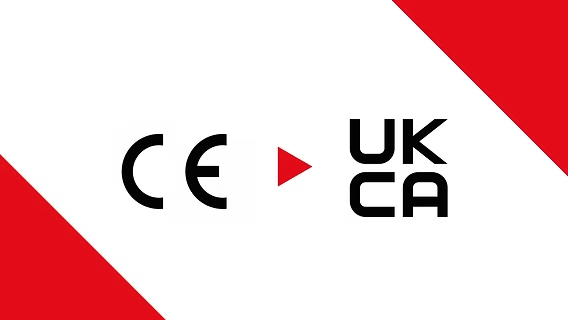
This means for the vast majority of product categories—including electronics, toys, and general machinery—importers can choose to use either the UKCA mark or the CE mark . This “dual-running” system was formalized to reduce the compliance burden on businesses and avoid disruptions to supply chains.
Where the Rules Differ
While the dual-track policy is a relief, it is not universal. The rules depend on your product type and your target market within the UK.
- Product-Specific Exceptions: Some categories have separate deadlines or requirements. For example, Medical Devices currently have CE recognition extended until 2028 or 2030, depending on the applicable EU regulation . Drone systems (UAVs) have mandatory UK-specific markings (UK0-UK6) as of January 1, 2026 . New regulations for outdoor equipment noise emissions took effect on April 13, 2026 .
- Northern Ireland: The rules for Northern Ireland are different. Under the Windsor Framework, goods placed on the Northern Ireland market must follow EU rules and bear the CE mark (or CE + UKNI mark) . UKCA alone is not accepted in Northern Ireland.
- Postponed VAT Accounting: For VAT, the UK’s Postponed VAT Accounting system is key. It allows you to defer the import VAT payment and account for it on your VAT return, which is a crucial cash-flow benefit.
Product Certification: UKCA vs CE
| Feature | UKCA (UK Conformity Assessed) | CE (Conformité Européenne) |
|---|---|---|
| Applicability | Great Britain (England, Scotland, Wales) | Northern Ireland & EU Member States |
| Current Status | Accepted in parallel with CE for most products | Accepted for most products in Great Britain until further notice |
| Examples | Electronics, Toys, PPE (Personal Protective Equipment) | Electronics, Toys, PPE, Machinery |
| Assessment Body | UK Approved Body (e.g., UK Notified Body) | EU Notified Body |
| Technical Documentation | UK-compliant technical file, Declaration of Conformity | EU-compliant technical file, Declaration of Conformity |
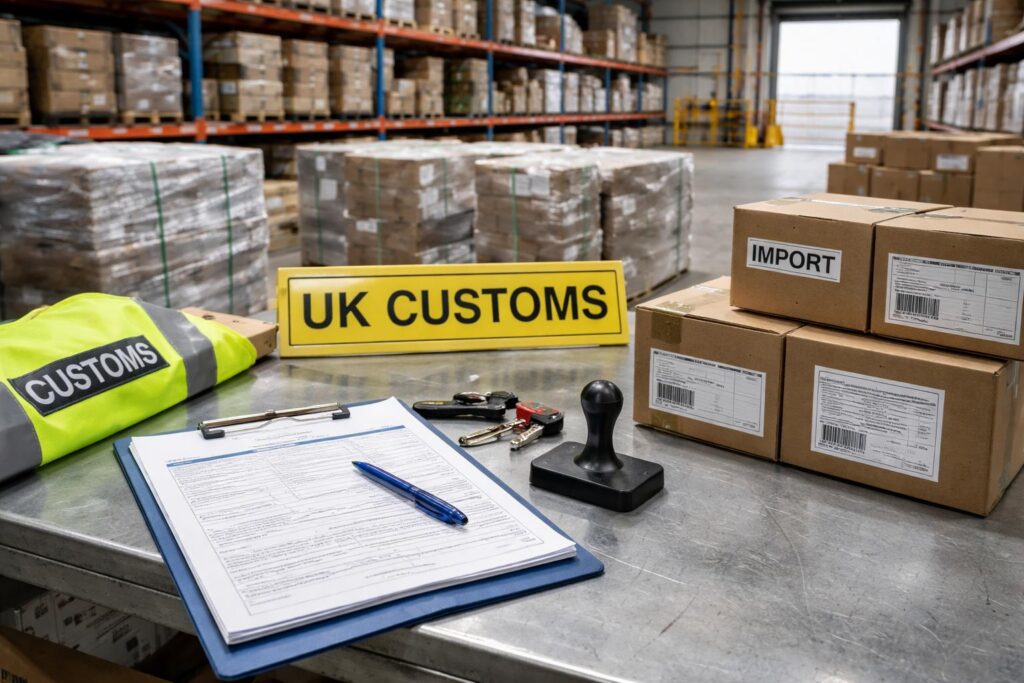
UK Customs: The “Super Strict” Regime

Why the Rules Are So Strict
Since leaving the EU, UK customs has transformed into one of the most rigorous in the developed world. The increased scrutiny is a direct consequence of post-Brexit policy . The UK established its own independent customs regime, including new systems like the Customs Declaration Service (CDS) and stricter valuation rules.
This has led to significantly higher inspection rates, especially for goods from Asia, as the UK combats undervaluation and fraud. The result is that 80% of customs delays are now caused by documentation errors.
The Core Rules for Alibaba Buyers
To avoid delays, penalties, or seizure, your shipments must meet these four standards:
- Reject Vague Descriptions: The era of declaring goods as “gifts” or “daily necessities” is over. HMRC requires a precise description of each item, such as “cotton t-shirt,” not just “clothing,” or “instant noodles,” not just “food”.
- Value Must Be Accurate and Verifiable: Under-declaring value to avoid tax is a high-risk strategy. HMRC actively uses data analytics to check shipment values. If an entry is flagged for low valuation, customs can detain the goods and demand proof of payment. Accurate valuation is crucial for avoiding these headaches.
- Prepare the Right Documents: A valid commercial invoice and packing list are mandatory. A correct EORI number is also non-negotiable; HMRC will not process a shipment without a valid EORI.
- Know the De Minimis Rules: The UK uses a de minimis threshold. The basic rule is: import VAT at 20% is due on all commercial goods. Customs duty only applies if the value exceeds £135. This is a critical distinction—a shipment under £135 is duty-free but not tax-free.
UKCA and Customs: A Unified Workflow
The certification and customs procedures are independent but both hinge on accurate HS codes and product classification.
- Confirm Product Type: Identify the exact product category (e.g., toy, electronics, machinery).
- Check Applicable Mark: Determine if your product needs a UKCA or CE mark (or is exempt). For most, CE is acceptable.
- Prepare Technical File: If UKCA is required, prepare the technical file and Declaration of Conformity.
- Verify HS Code: Check the UK Commodity Code, as this determines the duty rate. A correct UK commodity code is essential for the customs declaration. Use a HS Code Lookup tool to ensure accuracy.
- Prepare Customs Declaration: Prepare the commercial invoice, packing list, and EORI number. Ensure the invoice has a precise product description and accurate value.
- File via CDS: The importer or their customs broker must submit the declaration via HMRC’s CDS system before goods arrive.
- Apply VAT Accounting: Use Postponed VAT Accounting to defer the 20% VAT, which is calculated on the total value (product + shipping + duty).
- Plan Shipment: Estimate your total lead time (including potential customs delays) using Transit Matrix to select the appropriate shipping mode.
Tools to Simplify Your Process
- HS Code Lookup: Accurately classifying your product in the UK tariff system is the first step to correct duty calculation. Use our HS Code Lookup tool to find the right UK commodity code.
- Transit Matrix: Plan your shipping timeline and budget using our Transit Matrix to compare sea, air, and express lead times across different lanes. This helps you account for customs clearance time in your supply chain planning.
Conclusion: Compliance Is the Cost of Entry
The UK market in 2026 is a strict but predictable environment for importers who follow the rules. The dual-track UKCA/CE system offers flexibility for product certification, but the customs regime is unbending.
By verifying your product classification with a HS Code Lookup tool, planning your delivery schedule with Transit Matrix, and meticulously preparing your documentation, you can navigate the complexities and ensure your Alibaba goods reach their destination successfully.