
HS Code vs UK Commodity Code: What Alibaba Buyers Must Know Before Shipping to the UK
Table of Contents
If you have imported before, you know the term “HS code.” It is the six-digit international standard used in over 200 countries. But when you ship to the United Kingdom, you will hear a different term: commodity code.
These two terms are not interchangeable. The UK commodity code is built on the HS foundation, but it extends beyond it. Using a supplier’s HS code without converting it to the correct UK commodity code can lead to wrong duty rates, customs delays, and penalties.
This guide explains how the UK system works, how it differs from the EU’s approach, and what has changed in 2026.

HS Code vs UK Commodity Code: The Core Difference
What the HS Code Provides
The Harmonised System (HS) is the international standard developed by the World Customs Organization . It provides a six-digit number that describes a product and its qualities. This six-digit code is used by over 180 countries as the foundation for their own tariff systems.
Key point: The HS code is the starting point, not the full classification. It ensures that customs authorities in different countries classify the same product under the same first six digits—but what happens after the sixth digit varies by country.
How to understand UK Commodity Code
The UK commodity code extends the six-digit HS to a 10-digit number used for customs declarations in the United Kingdom. The structure breaks down as follows:
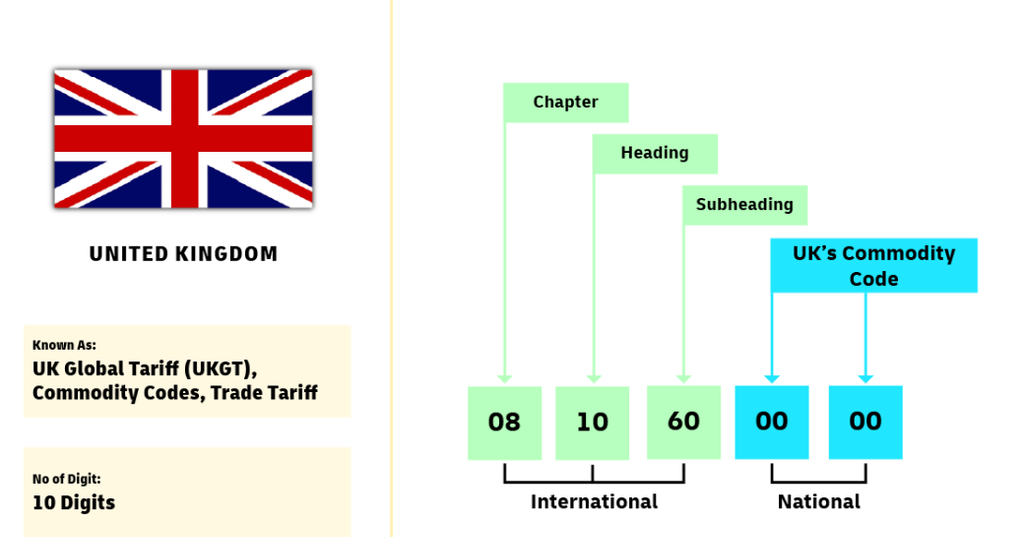
The first six digits of the UK commodity code are identical to the international HS code used everywhere else in the world. Digits 7 and beyond are always country‑specific.
Simple way to remember:
| Digits | Determined by | Globally unified? | Purpose |
|---|---|---|---|
| Digits 1–6 | WCO (World Customs Organization) | ✅ Yes, globally standardized | Basic classification of goods |
| Digits 7–8 | CN (Combined Nomenclature) system (historically used by the UK and still reflected in UK tariff classification) | Partly standardized within regional systems | Provides a more detailed classification of goods and supports trade statistics |
| Digits 9–10 | UK Government / UK Customs authorities | ❌ No, UK-specific | Used for UK-specific tariff measures, customs procedures, and regulatory requirements |
Therefore:
UK Commodity Code = HS Code (6 digits) + CN Code (2 digits) + UK National Extension (2 digits)
Where:
Digits 7–8 explain “the more specific category of the product within the international HS classification.”
Digits 9–10 explain “how the UK customs system manages this specific product, including applicable duties, controls, and regulatory requirements.”
Post-Brexit: The UK Global Tariff

Independent Tariff System Since 2021
The UK Global Tariff (UKGT) is the UK’s independent tariff policy, which replaced the EU Common External Tariff on 1 January 2021 . It applies to all goods imported into the UK and lists preferential measures where the UK has entered into new trade agreements .
UK vs EU: The Key Differences
Since Brexit, the UK and EU have been managing their own commodity code systems independently . While both share the same six-digit HS base, they have started to diverge at the national extension level:
| Feature | EU (CN / TARIC) | UK (UK Commodity Code) |
|---|---|---|
| Code length | 8 (CN) / 10 (TARIC) | 10 |
| Managing authority | European Commission | HMRC |
| Shared base | HS (6 digits) | HS (6 digits) |
| Duty rate basis | EU Common External Tariff | UK Global Tariff |
| Trade agreements | EU FTAs | UK FTAs |
The EU uses an 8-digit CN code for exports and a 10-digit TARIC code for imports . The UK uses a single 10-digit commodity code for both import and export declarations .
Practical implication: A UK commodity code and an EU TARIC code may share the first six digits, but digits 7-10 will differ. You cannot use an EU code on a UK declaration .
| Digits | EU Commodity Code | UK Commodity Code |
|---|---|---|
| Digits 7–8 | CN (Combined Nomenclature) code, used to provide a further classification of goods within the EU tariff system | The UK continues to use a classification structure based on the CN system, but it is maintained under the UK tariff framework |
| Digits 9–10 | TARIC additional code (Integrated Tariff of the European Union), used for EU-specific tariff measures, trade policy measures, and regulatory requirements | UK National Extension, used for UK-specific duty rates, customs measures, and regulatory requirements |
These changes affect 847 product categories. If your product falls into one of these categories, you need to check the updated duty rate in the UK Trade Tariff database. Old duty rates—whether from pre-2021 EU codes or pre-2026 US-UK agreements—are no longer accurate .
UK Import VAT: Always Applies
VAT Is Separate from Customs Duty
Even if your goods are under the £135 duty-free threshold, you must still pay Import VAT . The standard UK VAT rate is 20% .
How VAT Is Calculated
VAT is calculated on the total value of the goods, which includes :
- The customs value of the goods (product price)
- Plus shipping and insurance costs (CIF value)
- Plus any customs duty owed
Example: If you import £1,000 worth of electronics with £100 shipping and 2% duty :
- Customs duty: £1,100 × 2% = £22
- VAT: £1,122 × 20% = £224.40
Total extra cost: £246.40 + courier handling fee.
The £135 Threshold
You only pay customs duty if the item value exceeds £135 . However, VAT still applies on goods below £135. Low-value parcels (under £135) are not duty-free—they are only duty-free .
How to Find Your UK Commodity Code
Step 1: Use the UK Trade Tariff Database
The official source is the UK Trade Tariff look-up tool on gov.uk . Search by product description or your six-digit HS code. The tool returns the full 10-digit commodity code and the applicable duty rate.
Step 2: Verify at the 10-Digit Level
Do not stop at the six-digit HS code. Commodity codes are usually 10 digits in length . If a code is not defined to the 10th digit, the final digits are zeros.
Step 3: Consider a Binding Tariff Information (BTI) Ruling
If your product is complex or you are unsure about classification, you can apply for a BTI ruling from HMRC. A BTI is a written tariff classification that assures you have the correct commodity code.
Conclusion
The UK commodity code is built on the HS foundation, but it is not a copy of it. Here is the difference in plain terms:
The first six digits are identical worldwide. They identify the product type.
Digits 7–8 provides a more detailed classification of goods and supports trade statistics.
Digits 9–10 are used for UK-specific tariff measures, customs procedures, and regulatory requirements.
The bottom line: Always verify the full 10-digit UK commodity code using the official UK Trade Tariff tool before shipping. The correct code determines what you pay—and whether your shipment clears customs without delays.